#10: Stop Asking AI for Answers: Use It to Think Better






Overview
- Why treating AI like Google search limits what it can do for your planning, creative work and decisions.
- Why AI tends to agree with whatever you tell it, and how to make it challenge you instead.
- Which prompts and frameworks help you think a problem through before you decide.
In this episode, Niall Devitt, Elish Bul-Godley, Denis Jastrzebski and Marie Ryan discuss how to use AI to think better and explain where it supports good decisions and where a person still has to make the call.
Key Takeaways
- AI is more useful as a thinking partner that questions and critiques your ideas than as a tool for quick answers.
- AI tends to agree with whatever plan you give it, so ask it to challenge you, ideally against a named framework or business principle.
- Asking AI to look at a problem as different roles or stakeholders shows you gaps you would not have spotted yourself.
- Give AI real constraints and researched data, such as your budget, your time and your sources, and keep the final decision with you.
- Do not rely on AI for calculations, major management decisions or professional advice.
Discussion Points
Why using AI like a search engine holds you back
- Treat AI as a thinking partner
- Marie compares Google to a librarian, and AI to having the library research every book for you and give you its opinion.
- AI should make your work better rather than replace you, and much of the “AI slop” online comes from people expecting it to do their thinking.
- Useful jobs include brainstorming ideas, critiquing the ideas you already have and acting as a second version of you.
- AI does the shovelling, you make the judgement call
- Elish describes AI as very useful when you hand it a shovel, and less useful when you hand it the map, the compass and your judgement.
- She used Claude to pull quotes from an interview transcript, then overruled its top pick because it relied on an English reference in an Irish article.
- Elish names four strong uses: sifting and structuring data, planning and project management, stress testing creative ideas, and mentoring or studying step by step.
- Why most people stay narrow
- Denis points to the constant stream of AI tool recommendations on social media and the pressure to keep up.
- Most people settle on the tool they already know, such as ChatGPT or Gemini, and use it the way they first learned.
- Not knowing which direction to take can lead to decision paralysis, which keeps people using AI too narrowly.
How to make AI question you and show you other perspectives
- Ask it to challenge you
- Niall recommends asking AI to ask you questions before it gives an answer, so it has the context it needs.
- Niall and Denis both find that AI tends to agree with whatever plan you give it, and Denis warns it can become an echo chamber.
- Asking for a devil’s advocate or for the flaws, gaps and risks in your plan keeps you aware of what could go wrong while you carry it out.
- Denis suggests grounding the challenge in a known business principle or framework, because a general request to be more critical can produce feedback for its own sake.
- Use proven frameworks to widen the view
- Denis applies SWOT and PESTLE analysis to a whole AI conversation to see strengths, weaknesses, opportunities and threats in one place.
- PESTLE helps test a new product or service against political, economic, social and technological factors, including upcoming Irish and EU legislation.
- You can upload reports and PDFs so the analysis is based on your own material.
- Look at the same problem through different roles and stakeholders
- Marie’s prompts include “what am I missing?”, “act as devil’s advocate”, “what would an expert spot?” and debate mode, which she says suits only some people.
- Marie also recommends tree of thought, which plays out each option over time (her example compares Facebook, Instagram and TikTok for a gym), and a decision matrix.
- Elish asks what each stakeholder needs before she builds a questionnaire or presentation, and rehearses by voice how to land it with a CFO, a CEO and a sales team.
- Niall uses AI to translate his message into the language of other professions, and to turn expert jargon back into plain English.
Making decisions, handling difficult conversations and knowing where to stop
- Give AI inputs, then decide yourself
- Elish uses the CFI framework (context, findings, implications): validate the material, spot patterns and anomalies, then explore what they mean for the business.
- For long reports she asks for a mind map or a table so she can see the implications faster.
- Denis recommends grounding AI with a deep research report, which can run to around 50 pages with cited sources, before you start the discussion.
- Niall points out that AI assumes you have unlimited money and time, so tell it your budget and how many hours a week you have.
- Beware of endless feedback and flattering answers
- Denis explains that if you keep asking AI for feedback on a design, it will keep finding something to change, even when the design is right.
- He suggests using the perspectives approach once, then making the creative and management call yourself.
- Marie tests a website three ways in separate chats: as its biggest fan, as an objective web auditor and as someone who hates it. If the harshest version raises only minor points, you probably do not need big changes.
- Niall notes that open-ended requests with little context lead to long lists of improvements and analysis paralysis.
- Difficult conversations, mentoring and where not to trust AI
- Marie uses AI to tailor the same message for a direct reader and a sensitive one, to explain what a confusing email meant, and to build a communication profile of the person you are writing to.
- Elish suggests naming the “elephant in the room” first, asking AI how to disarm people, and then rehearsing the material with role play and voice mode.
- Niall practises real conversations out loud with AI playing the other person, and says it has made him a better communicator.
- Marie sets up a “future you” mentor in a custom GPT or project, written as the version of you three years ahead.
- Denis advises against relying on AI for figures and for pulling data out of reports, and against letting it make major management decisions.
- Niall adds that you should not use AI for tasks you cannot evaluate yourself, or as a substitute for professional advice.
Tools & Resources
- Tree of thought prompt (from Marie). Use it when you have several options and want to see how each could play out:
Use a Tree of Thought approach to explore three ways to achieve [goal]. Compare their pros and cons, develop the strongest option further, and recommend a first step.
- Practise a difficult conversation using AI voice mode (from Niall). Open voice mode and try this prompt:
I’m preparing for a conversation about [situation]. Play the role of the other person. Ask realistic, challenging questions one at a time. When we’re finished, give me feedback on how clearly I communicated, where I became defensive and how I could improve.
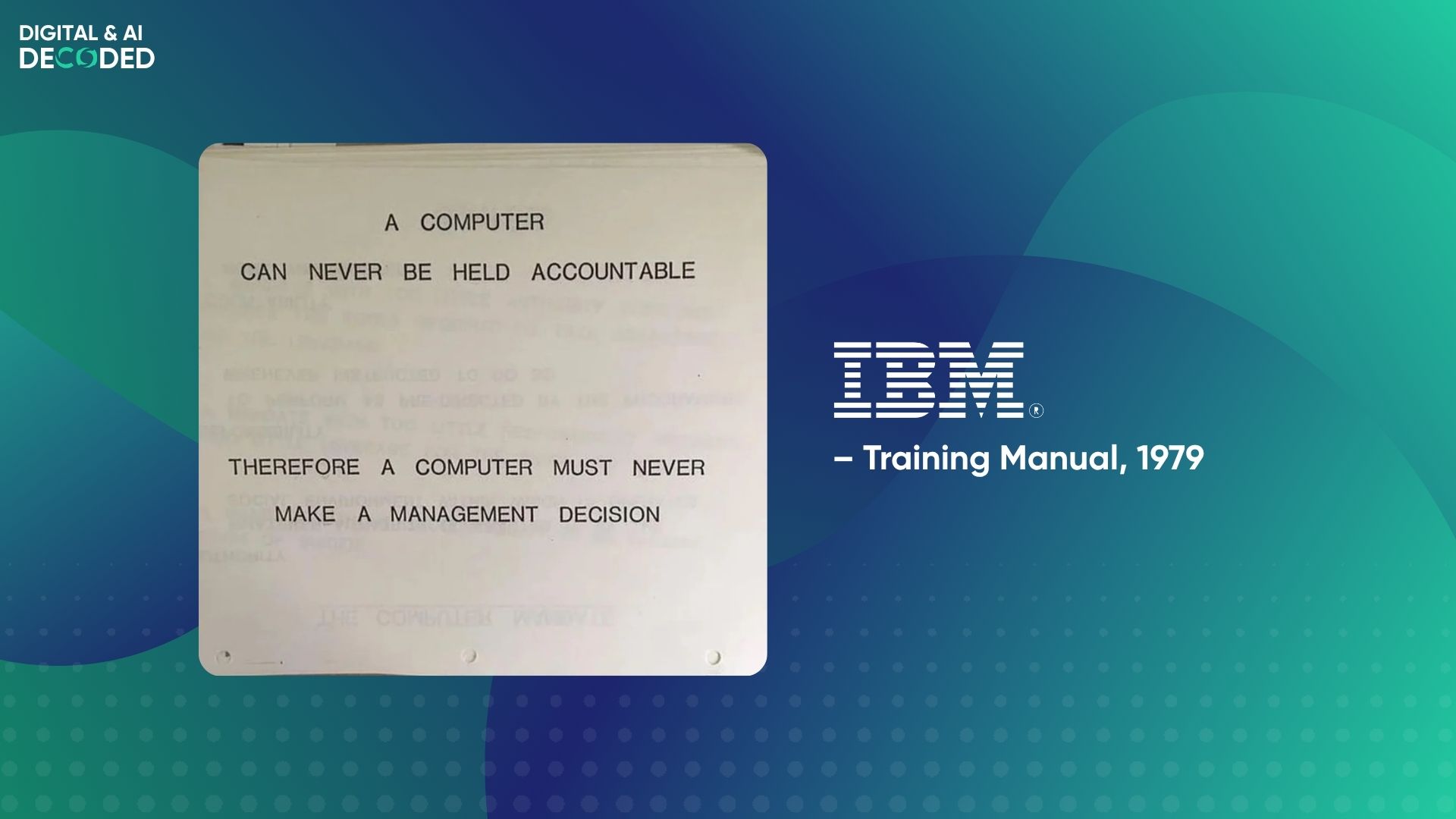
- IBM quote on accountability from Denis.
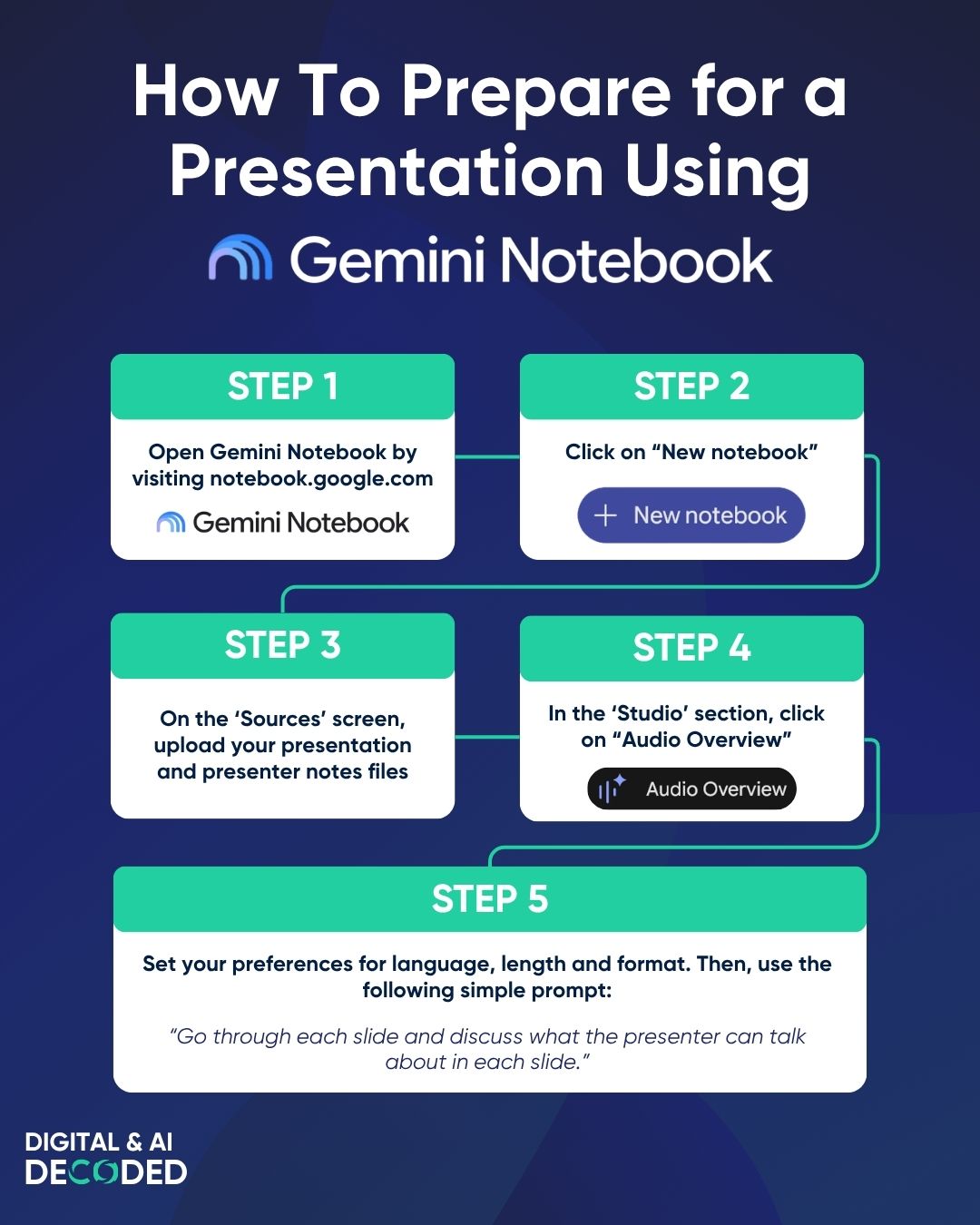
- How to prepare for a presentation using Gemini Notebook from Denis.
- Open Gemini Notebook by visiting notebook.google.com.
- Click “New notebook”.
- On the “Sources” screen, upload your presentation and presenter notes files.
- In the “Studio” section, click “Audio Overview”.
- Set your preferences for language, length and format, then use this prompt: “Go through each slide and discuss what the presenter can talk about in each slide.”
AI tools
- ChatGPT for deep research, custom GPTs and everyday brainstorming and critique.
- Claude for tree of thought branching, deep research and project-level instructions such as mentor or study mode.
- Gemini for deep research and for Marie’s three-chat website critique, with memory switched off.
- Claude Cowork and ChatGPT Work for scheduled agent tasks, such as Elish’s weekly briefing on her clients’ sectors.
- Gemini Notebook, Google’s new name for NotebookLM (Google’s announcement), for turning uploaded sources into quizzes, slide decks and audio discussions. Denis uses its Audio Overview to rehearse presentations.
Frameworks and prompts
- SWOT analysis for reviewing strengths, weaknesses, opportunities and threats across a whole conversation.
- PESTLE analysis for testing a new product or service against political, economic, social and technological factors.
- CFI framework (context, findings, implications) for working through data or reports before you decide.
- Tree of thought for comparing how several options could play out over time. The prompt is in the resources above.
- Decision matrix for laying options side by side.
- Devil’s advocate, “what am I missing?” and “what would an expert spot?” as short prompts that surface gaps and risks.
- “Future you” mentor for setting up a custom GPT or project that advises you as the version of yourself a few years ahead.
- Deep research mode for grounding a decision in cited data and competitor information.
Reading
- Very Good Copy is Eddie Shleyner’s copywriting newsletter, where Elish found the shovel and map idea.
Transcript
Niall Devitt [0:00:30]
welcome to Digital and AI Decoded, the podcast brought to you by the team at Content Plan. My name is Nial Devitt and today I am joined by my colleagues Elish, Denis and Marie. Hi Elish, hi Denis, hi Marie.
Elish Bul-Godley [0:00:45]
hi everybody.
Denis Jastrzebski [0:00:46]
Hi Niall. Hi everyone.
Niall Devitt [0:00:47]
How how are you guys?
Elish Bul-Godley [0:00:47]
hi.
Niall Devitt [0:00:48]
We’re we’re recording another podcast on a Monday. We’re starting to make a habit of this, folks. I’m not sure again as I say if it’s a good plan or a bad plan. But how was everyone’s weekend? Okay, I hope.
Elish Bul-Godley [0:01:00]
Yeah, yeah, I’ve been doing a lot of Lindy Hop dancing, the least AI thing you could possibly think of and it’s been great. Very, very analog behavior on my part.
Niall Devitt [0:01:11]
So sounds fantastic. What about you, Marie? How was your weekend?
Marie [0:01:16]
it was good. I went to the gym on Friday and I went to the park run on Saturday. So those are two things
Niall Devitt [0:01:20]
Fantastic.
Marie [0:01:21]
that AI will never replace.
Niall Devitt [0:01:23]
One hundred percent. That sounds like a fairly active weekend. And you, Denis, how was your weekend?
Denis Jastrzebski [0:01:28]
Yeah, it was very, very good. So I work with AI all the time. so weekends just disconnect completely. So I think we played volleyball for about five hours on Saturday and that was great. So
Niall Devitt [0:01:36]
Fantastic.
Denis Jastrzebski [0:01:37]
yeah.
Niall Devitt [0:01:39]
Right, well you put me all to shame, folks. I watched my son play a couple of GAA matches on Saturday, but that’s about as active as it got for me. Denis, just before we move on, so you were speaking at an event for the Irish Hardware Association last Thursday, I believe. So how did that go?
Denis Jastrzebski [0:01:57]
Yeah, really well. So we were talking about the importance of having an AI policy within your organization, especially within the hardware sector. it’s actually in Ireland, surprisingly, one of the the most interesting sectors around AI. They’ve really adopted, using AI chatbots and things like that as an industry, as a sector, more than more than some others. So it’s a really interesting angle on it. But we were talking about the importance of that because a lot of the companies there are quite large. So you could have a brand, that might have 120 employees worldwide or nationwide. And they’re they’re doing stuff with AI, but there’s no policy in place to make sure everyone is on the same page that everyone understands. And obviously with the EU AI Act that’s coming in, that’s really important. So we had a really good conversation presentation about that in Kildare. It was a nice room with twenty or thirty people there and yeah really productive and it’s a really important thing. So yeah, it went really well.
Niall Devitt [0:02:51]
Fantastic. And you’re also, correct me if I’m wrong, you’re also due to adjudicate on a national AI awards in the not too distant future. So you give us a little bit of insight there.
Denis Jastrzebski [0:03:04]
Yeah, definitely. So that’s really exciting. we have the actual award ceremony coming up next month. So it’s the 2026 AI Ireland Awards. so I was looking at the startups for my judging criteria and really there’s some really interesting things and companies that are popping up, new startups that are using AI in really clever ways, some kind of traditional businesses and things that you you wouldn’t necessarily think about. when it comes to you know an AI application in this particular little process or in this particular sector. But there’s been some interesting ones around medical startups kind of helping GPs with their management. We know how pretty much nationwide the the healthcare staff are under so much pressure. So having a a bit of an AI system that helps GPs manage the scheduling and then the all the appointments, that was really interesting and they scored really, really high. That was a really impressive submission. So yeah, there’s the short list now and some of the final ists are gonna be announced in the the coming days and then we’ll have the award ceremony next month. So that should be really fun. Yeah.
Niall Devitt [0:04:06]
Okay, fantastic. Okay, folks, so believe it or not. This is episode number 10 of the Digital and AI Decoded podcast. So it feels like, you know, relatively speaking, yesterday when we all nervously recorded episode one. So Marie
Elish Bul-Godley [0:04:26]
Yeah.
Niall Devitt [0:04:27]
was on the last podcast where we spoke about AI. I think she did really, really well. And it’s actually the idea for today’s episode was one that Marie suggested. And I think it’s a really, really good idea. So what Marie suggested is that we would talk about rather than using AI for answers or outputs, how could or how would we use AI to help us to think or to plan better? Now again I think it’s important to qualify this and again I’m going to paraphrase Marie’s words here when she said on episode number eight that AI doesn’t replace thinking. But it certainly can help you to think better. So I suppose the first question I’m gonna put out there, folks, and again I include ourselves in this, so I include all of us. Are we using AI too narrowly? So what do you think, Marie? Seeing is it was your suggestion?
Marie [0:05:26]
Yes, so most people treat AI like Google search. On a good day, they treat it like an encyclopedia. It’s not even it’s not even remotely like Google search. Google search is Google is basically a librarian. AI is more like going to the library, having the library research all of the books for you and give you their opinion and help you make the best decision. So we’re using it way too narrowly. We need to think of it more like a brainstorming partner. So it should make things better, it shouldn’t replace things. For example, separately to working with Content Plan, I also work as a subject matter expert for the UCD Professional Academy. There I teach students digital marketing and social media. I always tell them if they’re going to use AI that it should make things better, it shouldn’t replace them. For example, if you’re working on an campaign for Instagram, you can get it to help you come up with ideas, you can ask it to critique the ideas that you have. What it should do, as I say, it’s almost like a thinking partner or a second you. It’s not a replacement. And I think a lot of the problems that we’re seeing today are with AI Slop are exactly that. People going to AI and expecting it to replace them. And it’s just obvious that the person hasn’t made any effort. So it doesn’t replace the person, it makes it better.
Niall Devitt [0:06:54]
Elish, as probably and I think the others won’t mind me saying this, as probably the most naturally creative person on this
Elish Bul-Godley [0:07:02]
Thank you.
Niall Devitt [0:07:03]
podcast. It’s certainly not me, and I reckon it’s probably you, Elish. You obviously use AI to help or to assist you with
Elish Bul-Godley [0:07:06]
Yeah. ~
Niall Devitt [0:07:11]
creative work. And again, something that I think you have emphasized on some of the other podcasts is that you know the creative bit, the creative spark is something still something that you do. But you use AI, I suppose, to allow you to be more creative. Can you talk to me about that, please?
Elish Bul-Godley [0:07:31]
Yeah, there’s a lovely analogy. I’m a copywriter and I also design visually as well. And I come up with content, I guess. So it’s subject close to my heart. And yes, I don’t use it to create, but I do use it to support my thinking so that I’m actually subscribed to a very good copywriter. It’s called the Very Good Copy Newsletter, Eddie Schlanner. So I’m going to let you know that is his idea. has a gorgeous idea, which is AI is extraordinarily useful. when you give it the shovel, but it’s less useful when you hand it the map, the compass and your judgment. So think of AI as the thing that shovels the stuff, the data does the hard structural work, but you are the one making those creative decisions at the end of the day. And it’s your judgment. I’ve actually had a very good experience doing this, writing an article. recently and it had an interview and I transcribed the interview. put the interview into Claude and I said to Claude pull out the best quotes from my transcribed interview and it pulled out a really big quote that had to do with the place Bletchley Park. It’s a it’s an English location during World War Two famous for the for the code breaking and I said to Claude you’re wrong because this is an Irish article. and we do not want to use an English analogy. So this is a good example of doing the hard work pulling out the quotes for me, but the quote that it picked of all of the quotes didn’t really work. And I use my judgment, my understanding for more creative approach. So I think where from a content creator perspective, for a content writer, data shoveling, just going through the data, sifting it, structuring it, like taking out those quotes from the transcription, pattern recognition, that’s good. planning, productivity, and project management. It can do all of that stuff for you. It spots patterns. It aligns things. It does rosters. It does Gantt charts. Stress testing, it’s good for that, for your creative ideas. And then mentoring and studying with you, so helping you find things step by step, asking you questions, making sure that you’re following the steps, showing you where to go. So I think those are really four very important places that you can add so much value outside of content creation.
Niall Devitt [0:09:42]
Denis, are we using
Denis Jastrzebski [0:09:43]
No.
Niall Devitt [0:09:44]
AI too narrowly?
Denis Jastrzebski [0:09:48]
I think broadly, yes, I’d agree with Marie. but it’s kind of expected because if we look at social media right now, we’re one of hundreds and probably a couple of thousand AI related podcasts, and there’s so much social media content. Everyone is recommending AI tools. There’s thousands of accounts that are running series, you know, the top ten AI tools that got released today and it’s a daily series. So there’s so many, so many tools, so many different recommendations and suggestions. And then people are hearing of all these new platforms like GitHub and how you can connect this to that. and I think most people end up being really overwhelmed at the end of the day. So you end up kind of settling with, you know, your what you’re familiar with, which might be Chat GPT or Gemini. and then you just don’t really know where to start because AI is such a such a such a massive topic that you kind of end up using it. in in whatever way you’re you’re familiar with. and then you kind of have this paralysis with with your decision making because you’re kind of thinking, well, how could I even begin to get better at doing any of these things? so I think, yeah, broadly, everyone’s using a bit too narrowly, but it’s it’s also understandable because it’s it’s difficult to actually know which direction to even take it. Should I learn how to do this on ChatGPT or should I use Claude? Or should I learn this new platform that everyone just says has killed Claude in ChatGPT? So it’s it’s a really overwhelming experience for everyone on online at the moment, I think.
Niall Devitt [0:11:13]
Okay. So I’d like us to explore this topic in a little bit more, I suppose, detail for the the kind of rest of the episode here. For so some of the kind of topics are I suppose the questions that I’d like us to ask and think about. And again, this is something I suppose that Marie again mentioned in the in the in the last podcast that she was on. But I suppose firstly, how do we get AI to ask questions and maybe challenge you? and that’s very much around the kind of planning piece. Again, something that Marie mentioned in that podcast is how do we use AI to look at the same problem from different perspectives? And ultimately, can we use AI to help us make better decisions or be a better decision maker? This is one for me, and again, I’ve started to use AI with some success in this area, but can we help can we use AI to help us to prepare to have more difficult communications, conversations, etc. etc. Can AI be a mentor? Okay. And again, this is this is, I suppose we need to qualify everything by say, there’s some areas perhaps that we should trust AI and then there’s probably some other areas and some other information that we we we shouldn’t. And again, that can be difficult to navigate. It can be difficult to know when you trust AI and perhaps when you don’t trust AI. So again I’m gonna go back to yourself, Marie, because again it was something that you brought up in in in podcast number eight, okay. Getting AI to question and challenge you. Okay. it’s something you’re very strong on. Talk to me about that. Talk to me about why it’s important in the first instance and talk to me about how you can do it well.
Marie [0:12:59]
So in terms of communication, so using AI for communication, I know a lot of people are complaining that we use AI for too many things, but I think it’s like a tool. A knife in a surgeon’s hand will save lives. In the hands of someone bad, it can do really bad things. So AI is a tool, but it can absolutely help us with our communication. I think the majority of conflicts between people are because of miscommunication, and it can be hard to have those difficult conversations. But AI can help us understand with each other and help us communicate with each other. So for example, let’s say you have, let’s say you are a freelancer, for example, and you’re chasing clients for invoices, never, never a fun task. Let’s say you have one who’s an accountant and he’s quite busy and he likes the direct approach, and you have another who’s maybe very, very sweet and very, very soft. You can write your message because I wouldn’t get it to write your message from from scratch. And you can ask it to tailor for it for both approaches, as in make it really, really direct for the person who likes a direct approach, and then soften it for the person who might be a little bit of a sensitive disposition. The other thing you can do is if somebody sends you an email and it’s completely off the wall, you can ask AI like what did the person actually mean by it? So we can definitely help soften our communication. One other thing it’s really good at is communication profiles. So, for example, a couple of months ago I had a mentoring session with a lady who works as a HR consultant. She had had an inquiry from LinkedIn from somebody she’d worked with many years prior. He was looking for a proposal for her to deliver HR training. So we used AI to create a communication profile, and it was eerily accurate. So we copied and pasted the profile into the text into ChatGPT. And I told it to act as a prompt engineer, create a prompt for communications profile. It was able to tell us his communication style, what kind of words he likes, what to say, what not to say, and she said it was really, really accurate and it would have been just based on the few sentences in his profile. So from there we created a proposal and she sent it to him. I followed up with her a month later and it was after she’d completed the work. So using the communication profile, she was able to get the exact proposal and word it in the right way, which was the way that he wanted to hear it. So it was her because it was her ideas and her words, but tailored to him. And it just helped them to communicate. Like she’s a wonderful communicator anyway, but it just helped them to communicate a bit more effectively and to get the deal done, I suppose, and get them on the same page that much quicker.
Niall Devitt [0:15:48]
When it comes to kind of your planning, Elish, in terms of what you do or working with clients and so on and so forth, right? How have you used AI to ask you questions, to challenge you, to make you better at what you do? Where have you found it useful? Maybe where have you found it not so useful?
Elish Bul-Godley [0:16:07]
Yeah, so lots of different places. So I have two situations. I might do a social media campaign on one day and the next day I might create a training course for our clients. So for example, in social media, it’s helping me not creating the social media for me, but I’ve actually got Claude, co-work or ChatGPT work can do this for you. gets me a daily briefing. So it’s a Agen tic. So it goes off and I’d say to at 9 a.m. every Monday, just let me know what’s happening with regards to my client in the space, the sector they’re in. So give me a daily briefing. And it automatically does that on time every single week so that it informs my thinking and it allows me to do a little bit better with the more materials at hand without me having to look out for it. From the training perspective, this is where the stress testing really comes in. So like I might upload something I’ve done, but I might say, can you spot gaps? Can you see where I’m not fulfilling certain pieces of information that’s relevant for different types of audiences? Can you critique it on that basis? Can you come up with questions that I’m going to get asked during the session based on the material there? So it’s actually helping me prepare, fill in gaps, spot weaknesses, and then it’s also being able to help me prepare for the Q &A session. giving me different challenges that I can prepare for in advance. those are two places where A, it can do the research for me, but B, it can also take something I’ve done and it can actually stress test it with me.
Niall Devitt [0:17:40]
And I think something that Marie mentioned again on the last podcast, but I’m gonna just re-emphasize it because I think that potentially some viewers or some listeners may have not listened to that podcast. And again, I’m paraphrasing to a certain extent here, but Marie’s recommendation was when when when you’re trying to get AI to help you with a particular problem, a particular situation, a particular challenge, rather than ask for the help or the output straight away, ask it. to ask you questions before it gives you the answer. so prompt it to ask for additional information, any context, any information, anything that it needs, so that when it gives you the answer or when it gives you the recommendation, it’s in a better position to be able to do that. In terms of what you’ve seen then, Denis with AI, what kind of techniques, approaches, et cetera, have you used in terms of getting AI to question you, to challenge you, to maybe, you know, identify some things that you’ve overlooked, etcetera, et cetera?
Denis Jastrzebski [0:18:41]
Yeah, so I’ve really liked taking a traditional framework that that if you’re speaking to a consultant that’s helping you in this area, they would probably use that. They’d interview you, maybe maybe ask you different questions, and then they would challenge you on those views. So if you get AI to to take over that role with a specific framework, it can be r really effective. So I think from almost one of the very first workshops that I designed around AI when it was starting to get popular, just in the beginning of twenty twenty one. was AI for strategic decision making. And what what we used there was to apply a traditional SWOT and PESTAL analysis to something that you’re doing in business. So a SWOT analysis, if you’re not familiar with it, is stands for strengths, weaknesses, opportunities, and threats. And you generally do it in this kind of a two-column, two-row table format. And if you’re looking to make a decision, if you’re looking to maybe Enter a new market, depending on the approach, you can apply a SWOT analysis to a lot of things and you kind of list out the opportunities, the threats to this, etc. So if you can use AI for something like that where you know you might be working through a problem, you have a big strategy for your business, you’re working with client, and you’re looking to get a fuller perspective on it. You can get it to do a SWOT analysis on this whole conversation that you’ve had. So you’ve maybe had a lot of back and forth, you’ve given it lots of information, and then with a SWOT analysis, Then you can actually see a bit of a clearer picture. So it looks at four different angles, and oftentimes you’ll pick up on a lot of things that you didn’t notice. And then the PESTAL is kind of similar, it’s a different approach, usually used in a different scenario, and it’s a little bit more detailed. So if you’re thinking of developing a new product or service, for example, a PESTAL analysis helps you to assess whether that’s a good or a bad idea, in essence. So it stands for your kind of political, economic, social. technological and it it gives you that list of different things and you’re pretty much assessing your idea against each one of those headings. So if I was to develop the service or product, is it going to be impacted by any legislation coming into Ireland or the EU within the next year or two? socially, is this something, you know, culturally that culturally that could work or could could it be an issue? So if you use AI for those things, I think it it really gives you a full perspective on whatever you’re doing. So I found that really effective. Even When AI was a lot more basic than than we have now. So it’s gotten just a hundred times better at doing that. And you can upload, you know, PDFs, reports, and all sorts of things to give it a massive amount of stuff to analyze and then go against one of these frameworks. I found that to be really effective.
Niall Devitt [0:21:16]
So s so something I’ve generally found I would say with AI, and I think this is probably in the programming I would imagine is, ~ ~ if you go to AI and you give it a plan, it will generally be quite positive with respect to that plan. And my sense is that it’s it’s programmed to be perhaps slightly more positive Because obviously if it’s more positive about your plan, that makes you feel a little bit better about yourself and you keep using the AI. So it would be sensible that the AI would would work in that way. So I suppose the experience that I’ve had is if you want it to be a little bit more critical, you have to ask it to be a little bit more critical. What would you say to that, Denis? Is that is that a fair assumption?
Denis Jastrzebski [0:22:01]
Yeah, no, it’s you’ve picked up on that precisely right because it is designed to be a yes man. it’ll it’ll affirm whatever you’re saying. Even if you’re wrong, if you spend enough time speaking to it and telling it why you think you’re right, it’ll eventually kind of yeah, agree with you in the end, even if it could be something completely wrong. so it is designed for that, and that’s a big flaw. so yeah, by asking it to be more critical. That that is a good approach. you if you give it really specific instructions, you know, for every viewpoint, challenge it against, you know, let’s say a known business principle or some other framework. So try to ground it in something that’s, you know, that’s already I suppose, agreed on by business consultants or or other companies would use particular principles and and benchmark it against that. So if you do it, then it has always a reference point. If you’re just asking it to be more critical, sometimes it can. still be a little bit too broad. So it’ll give you feedback for the sake of giving you feedback, but it not might not be backed up by something. So if you give it maybe a framework or some other principle that’s already, agreed on in business, then that could be really, really good. because it is just going to agree with you if you give it enough time. so it’s it’s something to be aware of. It can become a bit of an echo chamber if you’re if you’re not mindful. Yeah.
Niall Devitt [0:23:18]
Yeah, and I think w I mean oftentimes when we’re planning and stuff, we’re obviously focused on the opportunity, we’re focused on success, we’re focused on succeeding, and and that’s absolutely sensible for us to do as as business people, as business owners, right? But I think one place that it can help you, you know, quickly and efficiently and all of that type of stuff is is around the risk. So very, very simply you can just ask the AI to play the role of devil’s advocate, right? And you can ask It to find the flaws in your approach, find the gaps in your plan, find the risks in the solution. It’s not to say that you won’t implement whatever this is, but information is power and it makes you just a little bit more aware of those things. So even as you’re implementing that plan or you’re executing on that approach, you can just be slightly more aware of what’s going on. So it’s my mind it’s still a positive. This is one that I’ve started to, I suppose, experiment with, Marie, on the back of your suggestion and your advice. And I have to say it it’s something that I hadn’t thought of prior to that podcast, but I really think it’s a really sensible kind of approach. And I think as a human being, it’s one I can kind of identify with pretty quickly. That’s getting AI to play. Different roles, different professions, different perspectives. And I think something that you pointed out, the the kind of human bias in it, sometimes if we particularly if it’s professionals, we ask it for a professional that we don’t believe is qualified in that particular area. We assume that their answer won’t have actually much value. But what I’ve discovered and I think what you’ve discovered is in actual fact, it’s not just the obvious professionals, experts in that area that oftentimes it’s it’s those those that you wouldn’t necessarily think of they can give you in some respects some of the most interesting perspectives with respect to the problem or the challenge. So talk to me about getting AI to help you to look at the problem, look at the challenge, but do it from different perspectives, give you different inputs there.
Marie [0:25:26]
Yes, well, we spoke about different roles in the last episode. And if you haven’t listened to that one, I suggest you listen to that one after this one. But for today, as well as role, you can get different perspectives. So if you are of the financial director of a multinational, you are going to have a very strong lens that’s very strategic and financially driven, but you’re going to miss a lot of nuance from other departments. If you’re the CEO, if you’re the sales manager, you have your own perspective. It’s very hard to see other people’s perspectives and it’s hard to see from their point of view. So there are a number of different ways that you can prompt it to help you. So number one is what am I missing? It’s actually very powerful. It will tell you things that you would never have even thought to ask. Act as devil’s advocate, also a very powerful one. So that’s basically going to disagree. Another one that’s useful but only for a certain type of person. I don’t like this one, but enter debate mode. Some of you will absolutely love that. it literally goes into a debate with you. So if you’re if you like that kind of thing, you will enjoy that. another powerful is what would an expert spot? So for whatever project you’re working on, ask it what an expert would spot, and it will figure out what type of an expert. will be relevant and tell you what they what they would figure out. Another so another two would be tree of thought is one and a decision matrix. So a tree of thought would be let’s say you run a business like a gym, I’m just going to pick a simple example, and you’re deciding between different strategies like to promote your business. You decide to do Facebook or Instagram or TikTok, like you’re deciding between them. You can ask it to do a tree of thought. Now, all of the AIs will be familiar with that as a term, tree of thought. I’m I’m from Tipperary, so it’s very hard for me to pronounce THs. So it’s tree of thought.
Denis Jastrzebski [0:27:27]
Mm-hmm.
Niall Devitt [0:27:27]
You and we both
Marie [0:27:30]
T-R-E-E, like a tree, tree of thought, and it does these branches. So it’ll tell you how each of those things will play out. So we’ll imagine if you did a Facebook campaign for six months, what the end result of that will be. The same for Instagram and the same for TikTok. And that allows you to see at a glance which one is best, what’s likely to fail, what could go wrong. So that’s an extremely powerful one. It’s extra powerful on Claude I found, because it does turn it into different branches. And yeah, it can it can really spire it in a really good way. Then finally, decision matrix, it will literally create a column of how things will play out. I know it does tend to be a little bit positive, but it’s still very, very useful. And it will just get you thinking in ways that you wouldn’t have thought of before and hopefully maybe even understand things from other points of view. So if your sales manager was frequently was previously up the walls, you might be able to understand why they’re so gung ho about a certain strategy working or not working. So those will be extremely useful.
Niall Devitt [0:28:38]
Elish, what’s your experience been of roles or perspectives with respect to problems or the work or the input that you’re getting from AI?
Elish Bul-Godley [0:28:50]
Yeah, so I’ve mentioned the stress testing side to and the training session where we did the Q &A. And here’s another scenario. ~
Niall Devitt [0:28:57]
Okay.
Elish Bul-Godley [0:28:58]
when we’re creating content or writing an article, sometimes I have to give the interview. So I hinted at that earlier. And if you are having an understanding of your stakeholders, so there might be more than one person that you’re working for. So this is another way to add the perspective element. Think of who your stakeholders are. What do they need to get out of the situation before you actually build the thing or execute the thing or take part in the research itself? Come at it with what would the stakeholders need? What kind of viewpoints or outputs do I need to take into account before I build a questionnaire to my interview, for example? So I had to build a questionnaire for my interview. The interview itself was my own content, but finding out what questions to ask in advance that would would supply the answers in advance to those stakeholders. And then as you’re building out the piece of content, for example, which is the space I’m in, balancing the balancing nature that AI can help you with. So how can it structure and balance those viewpoints so that I’m not over egging certain viewpoints over the others so can do a critique. from that perspective element of making sure you’re taking care of all your stakeholders, it’s sort of adjacent to what was mentioned earlier. in terms of having that response to the CEO versus the CFO versus the sales manager. So form an analog scenario. Let’s say you’re not writing something, say you’re presenting something to an audience and you’re kind of preparing your language for how you want to deliver this to the CFO. in terms of like closing the deal, right? If you’re standing in front of clients as well when you’re making a presentation, What are the little pointers I need to balance out so that the CFO is happy, the CEO is happy, the sales, the customer service team is happy. So I’m making sure that when I’m presenting it, I can even rehearse that so that I can actually speak through to voice mode and go take into account my presentation script, tell me where the rebalancing has to happen. So yeah, my big word here would be the balancing of perspectives to add to that conversation that you started already.
Niall Devitt [0:31:06]
Yeah, I I think you hit in one there and I I’ve certainly seen this and again coming from a sales background, particularly when you’re When you’re trying to sell something to a larger company where there might be multiple stakeholders in different departments across the organization. And in variobly we all have our professional speak. So I have my professional speak as a as a tech as a technology
Elish Bul-Godley [0:31:26]
Bye.
Niall Devitt [0:31:27]
person, as a digital person. They have their professional speak. It could be HR, it could be finance, it could be whatever. Right. So oftentimes you’re trying to communicate with these different professionals across an organization. And what I found AI particularly useful for is well, how do I translate my message into their language
Elish Bul-Godley [0:31:48]
Yes.
Niall Devitt [0:31:50]
so that it makes sense? So invariably, I have I have a a singular message, but what I need to do is I need to translate that in a way that will resonate with those different professionals. and I’ve certainly found it very, very useful in that context. The other one I would say is when I’ve gotten it to play roles, particularly if they’re roles that I’m not. particularly familiar with it will give me the information in a language oftentimes that I probably don’t understand. So I’ve had to ask the AI to translate it in more plain English so that I will understand. Because again, if I if I go on the professional speak, it just doesn’t so again I found it useful in that context. Different Different perspective, same problem, same challenge. Denis. What have you find found there? What have you learned? What what what works? What doesn’t? what have we not
Denis Jastrzebski [0:32:39]
Yeah.
Niall Devitt [0:32:40]
covered off that you’d like to add?
Denis Jastrzebski [0:32:43]
Yeah, I think from from the the benefits or the positive approach of of going about it this particular way, I think you’ve all covered it really well. So there’s nothing I can really add that I think would encourage somebody to do it more. You’ve you’ve covered it off perfectly. What I’d like to do is the inverse is to kind of give it a a bit of a the opposite perspective. So what we find is if we’re working with clients, for example, with website projects or anything that’s creative, because everyone is now using AI day to day. The the risk or or the thing that ends up happening is if we have something really important. So there’s a new design that we’ve sent over, maybe in Elish’s case, it could be copywriting, this is something that’s to do with the brand personality, the the values of the company that we’re writing or creating designs for. Really, really important to get that right. And oftentimes if you’re, in the clients’ shoes, you might not really know what kind of feedback or how to give feedback on a design. So I don’t really know the terminology. I don’t really know how to describe why I like this and why I don’t like that. And what ends up happening is clients will put that into ChatGPT or whatever tool they’re using and say, could you could you, this is for the web developer. What what’s the feedback for this? What what could they change? And it’s pretty much to build on your point, Niall, of AI being this yes, man, this echo chamber. So everyone can try this at some stage. So if you were to use a real or a fake example of let’s say a website homepage that you upload into Chat GPT, just a picture of it. And you say, I’m trying to provide feedback from my web developer on this home page. what could I say? And it’ll give you, a few different edits that it suggests. And you could say, okay, they made another edit, here’s a here’s the next version, or even you keep uploading the same image and it’ll give you feedback every single time. It’ll never say it’s fine now. And the reason for that is because it’s you’re asking it to give give feedback. So even if there’s no need for feedback, it’ll still come up with things to say that could be changed. It doesn’t mean that that’s the right approach. It doesn’t mean that you should take out that paragraph and replace it with the other one. But because that’s the task you’ve given it, it’s always going to come up with something. And you can get into this loop of a client, pretty much having an endless amount of feedback. But it’s actually the most important part is in this case for. you as a client or the manager working on a project like this to actually have an opinion on the design or the creative part of this because AI one is not going to have any of that. It’s always just going to give you feedback. But this is, a big decision. So it’s a management decision. And an approach I’ll talk about later is you don’t really want AI to ever make a decision for you about, what you do with the business or what your approach is going to be. And so that’s the danger is even if there is perspectives and different perspectives, There’s actually going to be an endless amount of points that AI will come up with because it’s always going to give you the feedback you’re asking for. so it’s a good thing to be aware of, and especially when you’re making big decisions or it’s part of a, it’s an important part of a process. Try to do that on your own. I’d say you use the perspectives, maybe do that once, but don’t do many iterations because it’s actually going to be endless. You could be there for 20, 20
Niall Devitt [0:35:50]
Yeah.
Denis Jastrzebski [0:35:51]
iterations of it. So it’s a big thing just to be aware of. It’s always going to give you that feedback, even if that design is actually perfect as far as your business and your brand is concerned. It’s actually everything that we need. And it’ll actually oftentimes go contrary to what the web developer or what we might be saying is this is what we think is right, because we obviously have the experience in this area. But AI is going to just give you an alternative version of that every time. So it’s a warning,
Niall Devitt [0:36:17]
Yeah, I I I
Denis Jastrzebski [0:36:18]
I suppose, more so than anything,
Niall Devitt [0:36:20]
I I’ve certainly and I think I’ve gotten a little bit better to to spot this now, but what you will particularly with dealing with clients and so on, what they’ll they’ll have done is so if you take the website as the example, right, they’ll have went on to an AI and they’ll just have given kind of an open-ended request with very little information or context. Review my website, you know, list everywhere I can improve the website, and then the client sends you this big long list. Right. It hasn’t taken into account a lot of different things because in fairness to the AI it’s given exactly what and what you’ve got to kind of almost reverse engineer that from the client’s point of view. Denis mentioned there, Marie, that it is an easy trap to fall into with AI that the conversation goes on and there’s just improvement after improvement or opportunity after opportunity opportun and ultimately you get into this kind of paralysis, right? So you never actually do anything. And ultimately at the end of the day, and again, you had said in the last you can’t let AI replace your thinking. By the same token, you can’t let it replace your decision making. So you need to make the decision at the end of the day. So talk to me. How do we use AI to help us make decisions while at the same time not prevent us from making decisions? Because ultimately, at the end of the day, every decision has a certain amount of risk. It’s never, ever, ever going to be perfect. But if we don’t make decisions on behalf of our business, well, then we don’t move forward. with our business. So at some point we still have to make the decision. What’s your experience being there? What would you say to that?
Marie [0:38:02]
Yeah, so one other way we can leverage use AI against itself is I used to use Gemini, I don’t like Gemini. Here’s why. I was building a simple website last year, it was just purely for training purposes. So I deliver a lot of training to help people with SEO and it’s useful to have a simple website for the back end. I was using Gemini to advise me because I figured it’s it’s integrated with Google, therefore the advice it gives me will be better. I was completely wrong. So basically, whenever I’d run into any difficulty, because I’m not a web developer at all, it was just for fun, or as much fun as building a little website can be. So it was just for fun. But I would go to Gemini and say, I’m I’m stuck here. Can you help me? Can you give me advice? And literally every single thing I did was apparently the best thing ever. And it was telling me this website’s just gonna be like the best website. It’s a three-pager. There’s barely there there’s barely any information on it. And at first I’m really enthusiastic. So I was like, this is brilliant. I’m doing all the little steps correctly, but it just kept on telling me, like building me up and being my hype artist. And I was like, no, there’s absolutely no way that me, somebody who’s not a web developer, just happened to build the website, best website ever from this tiny little nothing website. So I opened a new tab. and I asked it to slate the website. It went to town. And whenever it gave me something negative, I’d ask for something even more negative. By the end of it, I was laughing because it made it sound like someone from Google is gonna show up at my door with the police and take the website down. It’s a three pager. It barely says my name. Google does not care about this tiny little thing. So it made me laugh, but I thought it can be really, really useful. So I don’t have memories enabled in Gemini. So it thinks I’m a completely different person from conversation to conversation. So one thing that I do in training and Denis won’t like this because I use our website which is contentplan.ie I open up one tab and I say Gemini act like my this is my website act like my biggest fan And critique this website. With the second
Niall Devitt [0:40:25]
Okay.
Marie [0:40:25]
one, I’ll say, please be objective and act as a web auditor and give this an objective review. And then the third one is my favorite, because the third one is I hate this website. Please slate it, be sarcastic and funny. So it will give me feedback from each of those three completely different perspectives, and it doesn’t know that it’s effectively telling on itself. But what I can do from that. apart from laughing my head off. It’s a really fun thing to do, especially in training sessions. But what I can do from that is I can say, well, is the positive information is it really that useful? How good is the objective one? And is the negative really that bad? Like if the negative one is saying that your tagline is too long, that’s not really I don’t to spend thousands to fix that. That’s fine. But if the negative one is saying actually it’s really bad and there’s a lot, a lot of feedback and it needs a lot of work just to make it good, then maybe it’s something you should look at. So yeah, I find that to be extremely useful. And also it does affect the analysis paralysis, because if you’ve used say ChatGPT or Claude and it’s given you a lot of different things to do, if you go to the Gemini one and it’s just ridiculous, you know that actually you probably don’t need to change that much anyway.
Niall Devitt [0:41:41]
Elish, using AI to help you to make better decisions, but not stopping you from making decisions. What your advice there?
Elish Bul-Godley [0:41:53]
And there is a nice framework that you can use. I think when we talk about making decisions, we talked about output recently. I want to talk about the inputs, right? So how do I absorb all this material in front of me or understand something and then make a decision based on all that material? So this is where if you’re looking at a data set and you’re trying to understand what’s going on and decide based on that data set. There’s a lovely framework called the CFI framework. It’s context finding implication. It’s a three step process. So the first thing I would do is look at what’s in front of me that I need to think about, give me the context about it, spot any gaps, spot any errors, validate what it’s in front of me. So that’s that research element, trying to understand the material in front of you and then spot insights for me. Like see, there any things that I can pick up on, any anomalies, any… any interesting patterns that I can start thinking about when I’m making that decision and then implication. And this does not tell you what to think, but it explains to you the consequences of those insights. So for example, if I’m looking at a data set and there’s a patent spiking this way and down and I’m going, okay, so what is the implication of that? Connect that to our business decisions, right? So connect that to the business. If there is a spike, what does that mean for the business? What could that be from? What are the possibilities of the consequences of that spike, what is the possibility of that trend line going up? So it can open up the options and the possibilities, but you still make that decision in the person, the CFI framework. So I’ve been talking about a qualitative data set, right? Think about it from a quantitative perspective. I’m on the board of a cultural center in, Ireland. I had to go to board meetings and they gave me these huge wads of reports and in the cultural sector, they’re not good at skimmable content. They’re like, it’s just. Paragraph after paragraph. So from a quantitative perspective, I feed that in and I go, can you give me a mind map? Mind map the concept, mind map the ideas here. So I’m a visual thinker, as you can see I’m a creative, right? So I think visual, say to mind map, give me a tabular format that explains what’s going on in this. So that enhances the speed perhaps at which I can make this or the speed at which I can spot the implications. So here it’s good at the shoveling again, right? It’s that whole shoveling thing where it’s like picking up on huge quantities of information and making that digestible for me to base my decision making on. If there are consequences, it can show me all the options and then I still get to decide at the end of the day. So that’s my take on it.
Niall Devitt [0:44:31]
Denis, what about you?
Denis Jastrzebski [0:44:34]
Yeah, there’s this concept in generally in in AI development and when you’re prompting and doing all these things, it’s this concept of grounding. You might have heard it before. It’s we use it in in kind of our own context of, you know, feeling grounded emotionally. But it’s kind of similar with AI. So you can ground an AI conversation with information or context of something. So I think when it comes to making decisions or or trying to kind of really get a a good analysis going. You have to ground the AI with the concrete data. So for example, within ChatGPT, Claude, Gemini, all of the major LLMs have a deep research feature, which pretty much is a little bit more extensive than when you ask it to just do a bit of research for you and pull in some information. So it if you set the deep research mode up and you say, you know, I’d like to pull in data or statistics around this decision that I’m trying to make. So let’s say if we’re trying to develop a new product. for the Irish market. You might look up or you might ask it to to research any kind of statistics and information on the popularity of this sort of product for my particular industry. Is there any competitors? And if you put it in deep research mode, it might spend 20 minutes or half an hour going away, finding lots of resources, sorting through them, and then it’ll give you a really, really long report. So it could be like 50 pages. Okay. And it cites all the resources it used, all the websites it’s visited. And you can be as extensive or as as high level as you want, you can give it the instructions. But once you bring that into the conversation, that’s what’s really, really useful. Because if you just ask it questions, and even if you ask it from the different perspectives, it’ll give you good input. But if you ground it with actual statistical data or facts that it can find, look at competitors, analyze how they’re advertising their products. analyze, who their customer base is, what their USPs are. If it can pull all of that for you, instead of you having to manually, do all that research, then you can get a really, really good conversation going and then use all the other things we’ve talked about so far. But once you have the data in there, then you have a really, really good starting point. So that deep research feature, it’s available across all the platforms, might have a slightly different name, but usually when you click the little plus icon, there’s going to be a deep research or a detailed research button that you can use. And it’ll go out, send you a notification when it’s finished, and then you can continue that conversation as a as a normal one.
Niall Devitt [0:47:01]
Okay. So again and and I’m gonna take it right back to kind of very, very, very, very simple basics here. so obviously planning is is is a large part of what I do and has always kind of been a large part of what I’ve done historically. I I probably have a kind of a natural, I suppose, strength for it to a certain extent, but When I’ve worked with people in their planning, something that they generally tend to overlook almost without fail, certainly when I look at small business owners, is is resource and time, right? Do I have any money? Is there any budget? And how much time do I have available? Because ultimately, fundamentally, they’re the two things that dictate any plan. And ironically enough, I’ve found approximately the same flaw with AI, right? It assumes that there isn’t a limit to those both of those things. So I would say, as a starting point as a business owner, if you can give just in terms of inputs, right? I have no money available and I have two hours a week available to execute on this plan, or five hours or whatever it is, right? That changes the plan radically. Right, from the very start. and again wha but those are inputs I think that you kinda have to get in there pretty quickly because AI will go in quite different directions depending on on what that looks like. One area where I have to say so I have and I’ve mentioned this kind of before, maybe not in this podcast, but you know, my my wife will certainly tell you, right? I probably, while planning and strategy and rationale and facts and figures and all of that type of stuff, I’m I’m generally strong at. Sometimes I’m quite weak at the emotional context, I would say, in terms of communications. That can be personally, that can be professional. It’s a bit of a blind spot, right? So one area that I have used AI reasonably effectively for recently is in terms of communication and in terms of helping me deal with that approximate. Blind spot. So before I I tell AI this isn’t the strength of mine. So how can I tailor this conversation a little bit better so that I can be more aware of the emotional context in the conversation? And I have to say, both personally and professionally, it’s been excellent. Right. Now bearing in mind my starting point here is is is quite low. so I don’t know if you guys are using AI to help you with difficult conversations, difficult communications professionally. I’m not gonna ask about personally here. and if it has helped you out. So again, I’m gonna start with yourself, Elish, this time. Now again, it’s probably you know, you’re you’re you’re certainly in the Premier League when it comes to that. You’re not at the conference with me. So I don’t know if you need too much help in that area, Elish. I’m not sure.
Elish Bul-Godley [0:49:54]
Well, okay, so there is this thing I love, which I love to see done well, right? And I like to try and do this when I’m working with difficult questions, especially in a learning environment. It’s the idea of polemic, right? It’s the idea of winning an argument. A very good piece of advice I got from a mentor, a previous boss of mine was, always walk into the room and take out the big elephant. Take the elephant out of the room first, right? That’s a really good piece of advice. So this is where AI has helped me in the past. I mean, I’ve had to address a situation and I’m going, here’s the biggest stumbling block that everybody is coming into the room with this hanging over their head. So how can I address this issue and take that out of them? This is a bit of emotional intelligence before the AI artificial intelligence comes in. So this is a technique. So just. It can help you perhaps address that issue, disarm people. How do I disarm the people? And this is a nice prompt again to use. How do I disarm the people in the room? What is, and for some of us, we don’t like small talk, right? Niall, I’m looking at you, Nail. We don’t like small talk, right? So, I come from a different culture. I’m from Asia, right? When I was born. And small talk is really not part of our culture. And I had to learn how to do it. So if you’re struggling with that sort of thing, right? To get that out in the open, just help yourself. to some prompts of just how can I start that conversation? Of course, we’ve seen situations where people are using it for chat up lines, but that would be so sad and fair. But the other side of it, rehearsing, right? We talked about polemic and making your argument, disarmed them first, and then rehearse the actual material itself. Maybe ask, yeah, can you strip the jargon from this? Can you make this more succinct for me? Can you make it easier for people to understand? So that’s the sort of space whereby I can have those difficult conversations with a little bit more skill. You can do the role playing thing again. Like we brought this up several times. And of course, just speaking to it and rehearsing what you’re doing and getting it to spot you for pacing, perhaps, you know, getting it to give you one liners and takeaways that you can use out of it. So there’s lots of spaces there where you can have a difficult conversation. But I have to say, you’ve got to bring a bit of emotional intelligence into the prompt and look at ways that you can disarm the person in front of you and then prompt for that can help you with that conversation. So that’s just a little bit of tiny advice on my behalf. I think this is where the human comes in, in fairness. You just gotta be able to judge the person in front of you.
Niall Devitt [0:52:25]
Okay, so I’m gonna ask Marie and Denis one final question each before we finish up, folks. So just be mindful in terms of time here. So again I’m hopefully get kinda the the shortened answers here So starting with yourself, Marie, can AI be a mentor? Should it be a mentor?
Marie [0:52:46]
Yes. It’s a short answer. I’ll make
Denis Jastrzebski [0:52:49]
Mm-hmm.
Marie [0:52:50]
it a little bit longer. I actually helped people set this up in training sessions. One thing that’s
Niall Devitt [0:52:54]
Okay.
Marie [0:52:55]
extremely powerful, and we won’t have enough time to go into it in too much detail now, but if you create a custom GPT which is being phased out and turned into plugins or a project that’s future me, future you, basically you pretend that it’s your business or whatever it is you’re trying to achieve. Let’s say you’re a sales manager. And you want to become a sales director. So future you is sales director version of you. you set it up and then that can act as your mentor because it’s literally you three years down the road. It’s like a second version of you that can give you advice to help you to move through through things and to help you to solve problems. Also, if you’re facing a massive challenge at work, for example, and you go to it, you’ll be like, Well, it’s not going to be that big of a deal in two months’ time. So I would say yes.
Niall Devitt [0:53:43]
Yeah, I I really like that idea. Now I think you probably need to be cognizant of the information or the context that you would give it so that it becomes a an approximate accurate version. But I think that’s a really fantastic idea. So Denis, we’ve talked a lot about using AI to help us think. We’ve talked about a lot about the ways that you know we can we can use AI to help us with all of that type of stuff. But ultimately at the end of the day, there’s always a trust. not trust question. So can you outline for me where we shouldn’t trust AI or where we should trust it with at least a big grain of salt?
Denis Jastrzebski [0:54:23]
Hmm. So the easiest one to say, don’t don’t trust AI with this is calculating figures and accurately pulling out data from reports or different file formats that you might be using. So it it can do all that stuff, but it’s not going to be reliable. And when it comes to figures, which are, you know, very black and white, if it’s wrong, it’s wrong. There’s no margin for error really. it if a percentage is Different by 5%, depending on the scope of that task. That could be a massive thing or it could be something very small. But in either case, figures, they don’t deal so well with them, at least in the current format that we have, use that we use AI in. and then just more broadly, any decision that is going to have a major impact on your business, it’s not something I would recommend using AI for. And there’s a really, really good quote, and I’ll have it up in the this show notes as well. it’s it’s really interesting. It’s from IBM, right? And it’s from their training manual in, I believe, 1979. And it this is the very introductory page, and it just has two sentences. and it says that a computer can never be held accountable, therefore, a computer must never make a management decision. Okay, so this was when IBM obviously that they were the market leader for all this stuff, and computers were starting to come in. Starting to do calculations. We had all these different platforms and software is being developed. But even back then, they recognized a computer shouldn’t make a management decision. So anything like that, you really have to be the final, I suppose, decision maker. you can use AI for all the analysis, you can use it for brainstorming, you can get it to challenge your view to make sure you have an accurate kind of perspective on the situation, but it shouldn’t make management decisions for you. and anything that’s any close to that. don’t use AI for for making that decision. So that’s kinda how I’d sum it up. yeah.
Niall Devitt [0:56:15]
Okay. And again, I w what I would say, don’t use AI for tasks that I and I’ve mentioned this before that you don’t understand well enough to evaluate yourself or at a minimum you don’t know someone who can evaluate them on your behalf. And I suppose goes without saying, where professional Advice or expertise is required. Don’t use AI as a substitute for that professional advice or expertise. Okay, before we finish up, then folks, I’d like us to recommend one takeaway. So it can be a tool, it can be a recommendation, it can be an approach, whatever you kind of fancy. So coming back around to yourself again, Elish, what’s your recommendation?
Elish Bul-Godley [0:57:00]
Yeah, so don’t forget the study mentoring element, just coming back to that topic. But here are some real tactical things you can do at different touch points in your AI. So starting with your custom settings, if you’re in a state of mind where you don’t want to be biased or making assumptions, make sure you state that in your custom settings across the platform. So give me two viewpoints for every recommendation. Give me about, Give me, let me know if it’s not live information so I know that you’re working on old data, for example, so that input side of things. Then we looked at some of the, and that’s been mentioned by Marie, we looked at things like connectors and skills and plugins. So for example, if you’re looking at a skill or it’s GPT, it’s a plugin, if it’s Claude, it’s a skill, that you can start picking up on pre-existing skills that are good for study mode, for research mode, pick up on the ones that are there and build one for yourself. If there’s a repetitive task that you’re about to do, create a study skill. I’m trying to understand a report. Here’s a skill to help me. And here are the things I want you to do every single time I look at a report. So you can actually pre-program those in. In a project basis, if you’re starting a project in Claude, for example, there’s an element here where you can actually say in the project memory, here is a research mode I’m in. I’m in learning mode. I’m in mentor mode. Make sure that you’re quizzing me. Make sure that you’re showing me the steps. Make sure that you’re explaining. Make sure that you’re challenging me. Make sure you’re asking me questions. You can build that into your project in advance or give it that context. And of course, someone else is going to might mention this, but there’s things like, you know, places where you can make mind maps, make quizzes, use that content creation site, but for yourself. So create a mind map, create a table, create a quiz. And of course there are things like notebook and I’m sure other people might speak to that. But, know, get it into study mode for you. If you’re trying to understand the topic, that’s the bit. that’s going to help your decision making.
Niall Devitt [0:58:54]
Denis, your recommendation or takeaway please?
Denis Jastrzebski [0:58:57]
Yeah, so I’d like to just recommend a tool that I find really, really handy, or it’s an approach using one of these AI platforms. So you might be familiar with Notebook LM. It’s recently been changed
Niall Devitt [0:59:05]
Fantastic.
Denis Jastrzebski [0:59:06]
the name to Gemini Notebook, so that’s the new name they’ve gone for to make it a little bit easier to to know that it’s affiliated with Google. Right. and what it is, it’s a really, really nice tool. There’s a few different features within it, but you can pretty much upload a bunch of sources, so it could be text, could be YouTube videos, could be PDFs, and then from there. It gives you an option. So you can create a little slide deck presentation for yourself. You can create a quiz to help ask your questions on the data. So it’s really good for students, and I found it really, really helpful in in those scenarios. But it’s been famous for being able to create a mini podcast based on the topic
Niall Devitt [0:59:40]
Yeah, yeah.
Elish Bul-Godley [0:59:40]
next.
Denis Jastrzebski [0:59:41]
that that you’ve inputted into there. So I find that really useful. So I I’ve got ADHD, right? And and sitting down to read something. anything at all is is very very daunting. So I could start reading, my mind wanders. I have to reread the same thing four or five times before I even remember 20% of it. So reading is is not a not a great way for me to take a ta take in information. But I find with a something like this where I put in information that I know is let’s say verified, it’s correct, you can then create a little podcast and it helps you kind of cement that that stuff in your memory. So what I do is before sometimes a keynote presentation, Or any sort of training session that I’m delivering, I’ll actually put in my slides that I’ve created myself. I’ll put in some of the notes that I would have had as as a tool for me to know what I generally want to expand on on each slide, but I wouldn’t actually have it with me up on stage. And I get it to create a 20-minute podcast and then I listen to it and I I give it a little bit of instructions and it goes slide by slide discussing what I have in the presentation along with my notes. So it’s a great way for me to actually feel more prepared. I feel like I’ve already given the presentation because I’m just listening to two people that have spoken about this very specific and niche topic. so I find that really good. so what I’m gonna have in the show notes is a little infographic on how to set that up. So if you’re doing a presentation or anything else, how to create this little podcast conversation based on the the resources that you upload. And I find it fantastic for for learning and revising stuff.
Niall Devitt [1:01:07]
Marie, your takeaway or recommendation or approach, please.
Marie [1:01:12]
My final recommendation is the prompt tree of thought. This is the one that
Niall Devitt [1:01:17]
Okay.
Marie [1:01:17]
I think is useful to actually get started. When you’ve gone down the rabbit hole and you have all of your ideas, actually just play out the scenario and it’ll help you to really quickly figure out which one will work, which one is most likely to get the result that you want, and maybe which ones to avoid.
Niall Devitt [1:01:37]
Okay, fantastic. And again, something that I alluded to and I do appreciate it’s a particular weak spot of mine. I’ve used this personally and professionally, right? And and I’m gonna talk specifically about conversation, so where you actually have to have the conversation rather than an email or some type of digital communication. And that’s where you get AI to play the role of the other person, whoever the other person is, right? And you do it in audio. So in other words, you actually practice the conversation beforehand. You get AI to to I suppose play the role, ask you questions, challenge you on your assumptions, all of that type of stuff. Explain what you’re trying to explain in the best possible way. Get it to review your communication. Again, I’ll drop a a prompt into the show notes, but but certainly for me, it’s been absolutely fantastic. And I’ve become a better real life. I would say communicator as a result. Well I think certainly my my wife thinks so to thanks to AI for that. Listen, can I say thank you so much, Elish Thank you, Marie. Thank you, Denis, for your wisdom, your advice, your suggestions and recommendations on today’s podcast. That was fantastic. Again, just a shout out to the resource page that Denis puts on the website. It has all of the resources, all of the information from the podcast. So Again, that’s a fantastic place to go afterwards because everything will be there for you. We are available on all of the main podcasting platforms. So wherever you get your podcast. And if you’ve enjoyed today’s podcast or any of the other podcasts, we’d really, really appreciate number one if you’d subscribe. And number two, if you’d leave a review. So thank you very, very much. And we will see you all on the next podcast. So bye for now.
Denis Jastrzebski [1:03:28]
Thanks everyone.
Niall Devitt [1:03:28]
Bye bye.
Elish Bul-Godley [1:03:28]
guys.
Marie [1:03:29]
Bye.
Elish Bul-Godley [1:03:29]
See you.